
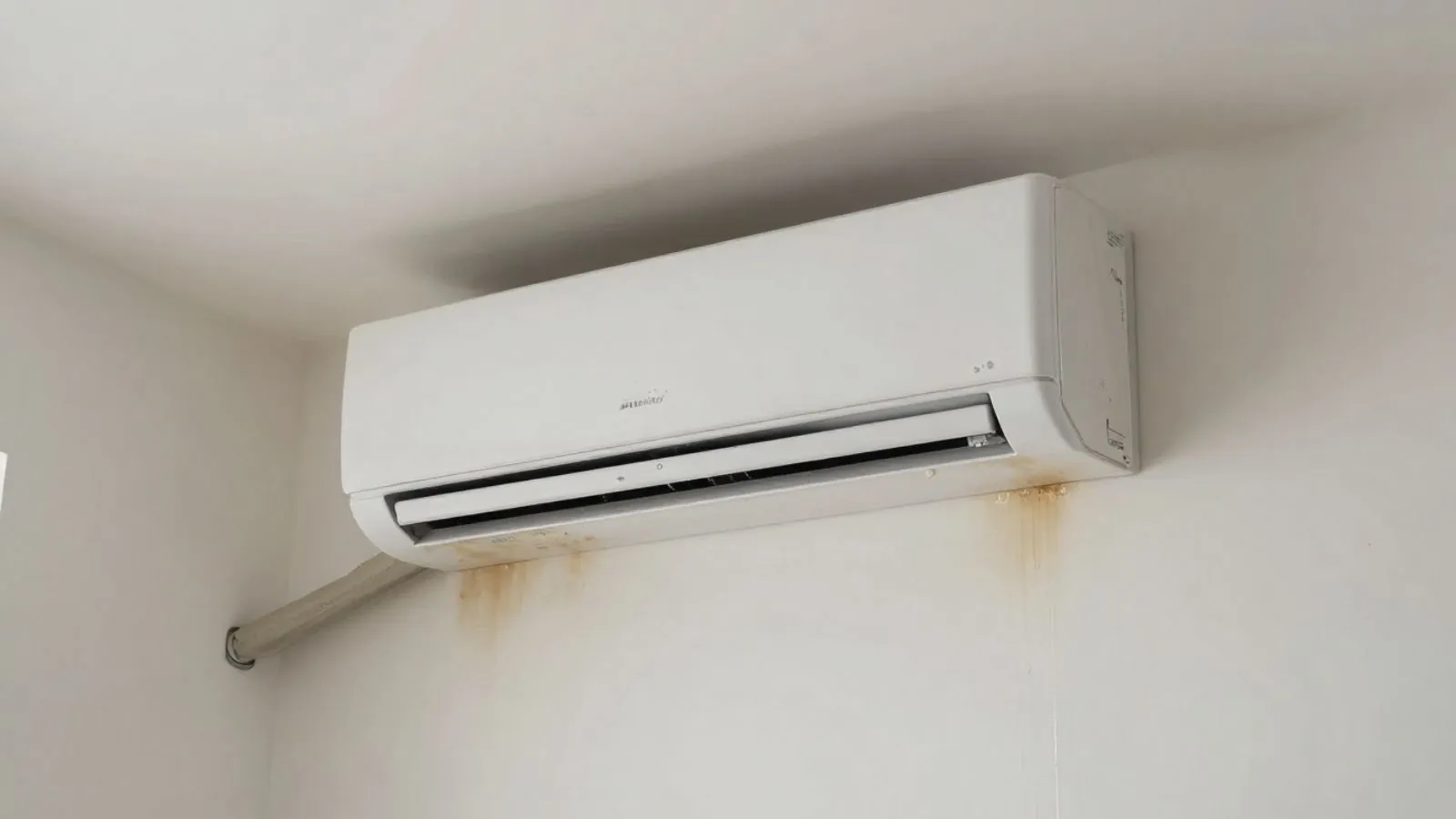
Cooling air pulls moisture out of the house, and that moisture collects on the evaporator coil and leaves through a condensate line into a drain pan or a drain. When the line clogs, the pan overflows or the float switch fails, the water goes into whatever sits below the air handler. If water is dripping from a vent or ceiling right now, turn the system off at the thermostat and call us.
Where AC water ends up
An air handler in an attic drips onto insulation and then the ceiling drywall below. One in a closet or garage soaks the floor, the base of the wall and anything stored on it. A split-system indoor unit mounted high on a wall can run water down the wall face and into the baseboard.
The HVAC technician fixes the cooling system, and that includes clearing the line and replacing a switch. Our side is the water that already escaped. Both visits matter, because drying a ceiling under a line that is still clogged only buys a few more days.
Signs the condensate line is the culprit
Stain below an attic unit
A brown ring that grows on hot days and shrinks on mild ones follows the run schedule of the system.
Water in the secondary pan
A pan with standing water means the main drain is not keeping up. Pans are a warning, not a fix.
Unit stops on its own
Many systems have a float switch that shuts cooling off when water rises. A system that quits and a damp spot nearby go together.
Musty smell near the air handler
Damp insulation or drywall holds odor long before a stain shows. A moisture meter finds it faster than a nose.
Safety steps for the first hour
Switch the AC off at the thermostat and at its breaker if you can reach the panel while standing on dry floor. Ceiling light fixtures and fans can collect water above them, so leave them off and keep your hands away from any that are dripping.
Do not poke a bulging ceiling, since it may hold more water than it looks. Put a bucket under a drip and move furniture and electronics out of the path. Photograph the stain, the unit and the pan before anything is touched. If you see sparks, smell burning or the water touches the panel, call 911 or the utility before calling us.
Ceiling dripping under an air handler?
Tell us where the unit sits and how long it has run wet. The line is open 24/7.
Why long cooling seasons matter here
NOAA climate normals for the Thousand Oaks area describe warm dry summers and an average of 17.35 inches of rain a year. Months of dry heat mean the air conditioner runs for long stretches, so a blocked line can drip daily for weeks before anyone looks up. If the stain is large, assume the leak is older than it seems and ask for readings across the whole ceiling, not just the ring.
Newbury Park has older areas such as Casa Conejo and Ventu Park, and newer ones such as Dos Vientos Ranch and Rancho Conejo Village. We have no data on which equipment sits where, so we go by what the meter and camera show.
How we dry and repair AC water damage
Confirm the water is off
We check the pan and line, and that your HVAC technician has cleared or scheduled the fix. We will not start drying under a live drip.
Map the wet area
A thermal imaging camera shows cool wet zones across the ceiling and a moisture meter confirms them in drywall and framing.
Remove wet insulation and board
Saturated attic insulation comes out first. Soft drywall is cut back to dry framing so the cavity can breathe.
Dry with air movers and LGR dehumidifiers
Equipment runs until readings match a dry reference point, with logs you can keep for your insurer.
Repair and finish
New board, taped joints, matched texture, stain-blocking primer and paint close the job once everything reads dry.
What changes the scope and the cost
The main drivers are how long the leak ran, how much insulation got wet, how far the water spread along the ceiling or wall, and whether flooring or cabinets sit below. Access matters too, because a unit in a tight attic takes more time to work around than one in an open closet. Texture and paint matching add to the finish stage. We explain the scope and the price before any work starts.
Insurance and a slow drip
Insurers tend to separate a sudden overflow from a clogged line that dripped for weeks, which can be treated as gradual. The California Department of Insurance publishes general guidance, and your own policy wording decides. Read your policy wording or call your insurer, and keep the photos, the HVAC invoice and our drying logs together.
| Situation | Usually looks like | What to do |
|---|---|---|
| Float switch fails and pan overflows once | Sudden stain, one event | Document it, dry it, report it promptly |
| Clogged line drips for weeks | Large old ring, soft board, odor | Expect questions about gradual damage, keep every record |
| Drip reached flooring | Cupped boards or lifted edges below | Ask for moisture readings in the subfloor |
| Damp for many days | Dark spotting on insulation or board | Call about mold remediation before repair |
Mistakes to avoid
Do not paint over the ring or restart the system before the line is cleared. If water reached wall cavities and carpet, water mitigation covers the drying stage, and water damage repair finishes the room. We also serve Thousand Oaks and Camarillo. Our drying follows the published ANSI/IICRC S500 reference, and you can ask any other contractor which practices it follows.
Frequently asked questions
Is emergency AC leak water damage repair available in Newbury Park?
Yes. The line is staffed all day and all night, including holidays, with same-day response when available.
Can an AC leak cause mold?
Mold needs moisture, and insulation or drywall that stays damp for several days gives it that. Fix the water source first, dry the materials, and have the area checked before it is closed up.
Health questions belong to a physician.
Who fixes the air conditioner itself?
An HVAC technician clears the line, replaces the pan or float switch and tests the system. We dry and repair the building. We work in that order so the same leak does not return.
How do I know if the ceiling is dry enough to patch?
Not by touch. A moisture meter reading on the board and the framing, compared with a dry area of the same room, tells the truth. A thermal camera can also show cool spots still holding water.
Will a stain come back after painting?
It can if the board stayed wet or the stain was not sealed. A stain-blocking primer coat over dry, repaired board is what stops the ring from showing through.