
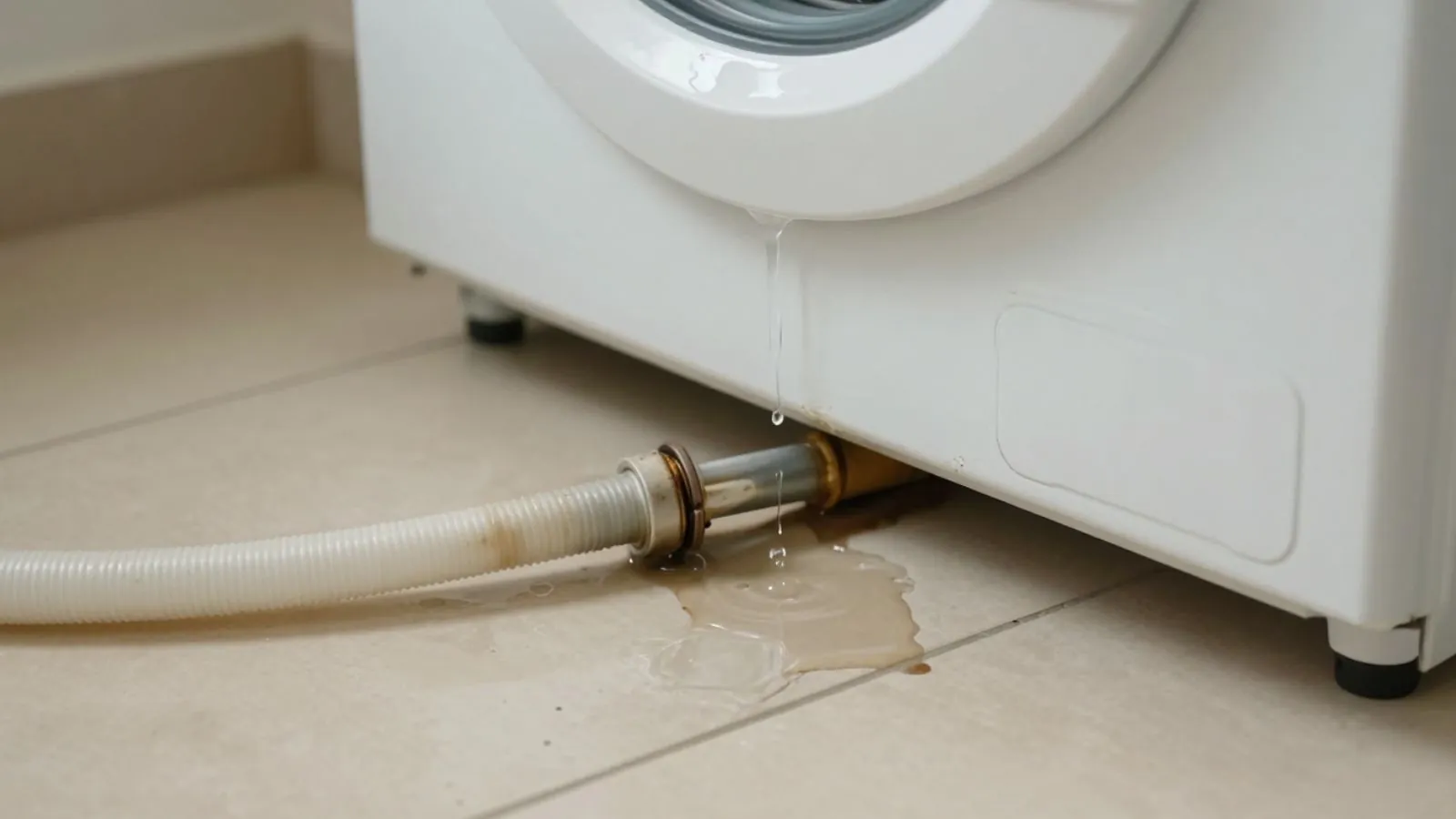
Appliance leak water damage is what happens when a supply hose, valve, drain line or pan on a washer, dishwasher, refrigerator or similar unit lets water onto the floor and into what sits around it. Call at once if water is still running, if it has reached an outlet, or if a ceiling below a laundry room is stained. Otherwise shut the appliance's valve, unplug it if the cord is dry to reach, and call.
Where appliance leaks start
| Appliance | Common failure point | Why it goes unseen |
|---|---|---|
| Washing machine | Rubber supply hose or the wall valve | Hoses sit behind the unit and fail under steady pressure |
| Dishwasher | Inlet line, door gasket or drain hose | Water runs under the unit and into the floor edge |
| Refrigerator | Ice-maker supply line or a clogged defrost drain | Small tubing leaks slowly behind a heavy unit |
| Water softener or filter | Fitting or drain line | Often in a garage corner or closet |
| Condensate or drain pan | Overflow or cracked pan | Water collects out of sight below the appliance |
A hose that bursts floods a room in minutes. A pinhole or loose fitting is slower and more costly in the end, because it can wet a subfloor for weeks before a floor feels soft.
Hidden leaks under and behind appliances
The signs are often small. A baseboard that swells beside the washer, a floor that sounds hollow near the fridge, a faint musty smell in the laundry closet, or a water bill that creeps up without a change in habits can all mean a hidden line is wet.
Upstairs laundry rooms add a second problem. Water that gets past a floor drain or pan drips through the ceiling below, so a stain in a downstairs room can trace back to a washer overhead.
Newbury Park has housing of mixed ages. Public community histories describe Casa Conejo as the first planned community here, while Dos Vientos Ranch and Rancho Conejo Village are the major newer areas. We do not know the age of your hoses from the neighborhood, so check the date or wear on them regardless of where you live.
Water coming from an appliance?
Call the 24/7 line and tell us which appliance and what floor sits below it.
Safety steps before you move the appliance
Close the appliance's own shutoff valve first, usually a small lever or knob on the wall. If it will not turn or water keeps coming, the meter or main valve is next, and the City of Thousand Oaks Find Your Water Provider map at toaks.gov/waterproviders shows which of the four Conejo Valley providers serves you. Read your bill or check the map ahead of time so you are not searching during a leak.
Washers and dishwashers are heavy and hold water in the tub and hoses, so do not drag one across wet flooring. Unplug it only if the outlet and floor are dry. If water touches an outlet or power strip, stay back and call your electric utility or 911 before calling us.
How we trace and dry an appliance leak
Find the real source
We check valves, hoses, drain connections and pans, and run the appliance briefly if the plumber or owner agrees. The visible puddle is not always where the water starts.
Pull the unit
With the appliance moved, we can see the floor edge, wall base and any ceiling below. Hoses and valves are photographed for your records.
Measure moisture
A moisture meter and thermal imaging camera show how far water traveled under flooring and into the wall base.
Extract and dry
Extraction units remove standing water. Air movers and LGR dehumidifiers dry the floor, subfloor edge and wall base, with injection or small openings when a cavity stays wet.
Verify before reset
We take readings again before the appliance goes back, so a wet floor does not get covered over.
Drying follows ANSI/IICRC S500, the published industry reference, and homeowners can ask any contractor which practices it uses. If the water reached cabinetry, see kitchen water damage restoration for that side, and for the drying stage itself read about water mitigation.
What changes the cost
Scope follows how long the leak ran, how much flooring and wall base got wet, whether a ceiling below was reached, and how easy the appliance is to move. A quick supply hose failure caught in minutes is a smaller job than a drain leak that ran behind a washer for weeks. Scope and price are explained before work starts.
Why a slow leak matters for a claim
A hose that bursts overnight is generally judged differently from a drain line that wept for months, and policies vary on both. A burst hose is easy to describe as sudden. A fitting that dripped for months is harder, so note when you first saw dampness, photograph the hose and valve, and keep the old part.
Read how your policy treats appliance leaks, or call your insurer to ask. Our written scope and moisture readings give you documentation to hand over.
Mistakes to avoid
- Pushing the appliance back into place before the floor is dry.
- Using bath towels on a leak and ignoring the wall base behind the unit.
- Throwing out the failed hose, which helps show how the leak started.
- Leaving the supply valve open on a washer for days away from home.
If a stain shows up below, read how AC leak water damage repair differs. We also serve Moorpark and Oak Park when an appliance fails there.
Frequently asked questions
Is emergency appliance leak water damage cleanup available in Newbury Park?
Yes. Someone answers the phone at any hour, including holidays, with same-day response when available.
How do I know a washing machine hose is about to fail?
Look for bulges, cracks, rust at the couplings or a damp wall valve. Rubber hoses wear from the inside, so a hose can look fine and still be near failure.
Replacing old hoses and closing the valves when you travel are simple precautions.
The floor feels dry but the dishwasher leaked. Do I still need a check?
Often yes. Water runs under a dishwasher and sinks into the subfloor edge, which a dry surface does not show. Readings with a moisture meter tell you whether it is dry.
Who fixes the appliance?
The appliance repair company or a plumber fixes the hose, valve or unit. We trace the water, dry the affected area and document what was wet.
Can a leak from a laundry room damage the room below?
Yes. Water follows the floor structure and drips through ceilings, so a stain below an upstairs laundry may start at the washer. Shut the valve, then call for a check of the ceiling.